Image credit: Unsplash
A complete beginner set with driver, woods, irons, wedge, and putter costs $300 to $600. You don't need 14 clubs starting out. A set of 10-12 is plenty.
Start with a game-improvement set from Callaway, Wilson, or Top Flite. These clubs have larger heads, wider soles, and more forgiveness on off-center hits.
Best beginner golf club sets in 2025
| Set | Clubs included | Price | Best for |
|---|---|---|---|
| Callaway Strata Ultimate | 16-piece (driver, 3W, 5W, 5H, 6-9 iron, PW, putter, bag, 3 headcovers) | $400-$500 | Best overall beginner set |
| Wilson SGI | 14-piece (driver, 3W, 5H, 6-SW, putter, bag) | $350-$450 | Best budget set |
| Top Flite XL | 13-piece (driver, 3W, 4H, 5H, 6-PW, putter, bag) | $250-$350 | Cheapest starter option |
| Cobra Fly-XL | 13-piece (driver, 3W, 5H, 6-PW, putter, bag) | $500-$600 | Best quality budget set |
| Cleveland Launcher XL Halo | 11-piece (driver, 3W, 4H, 5H, 6-PW, putter) | $600-$700 | Best if you plan to stick with golf |
What clubs does a beginner need?
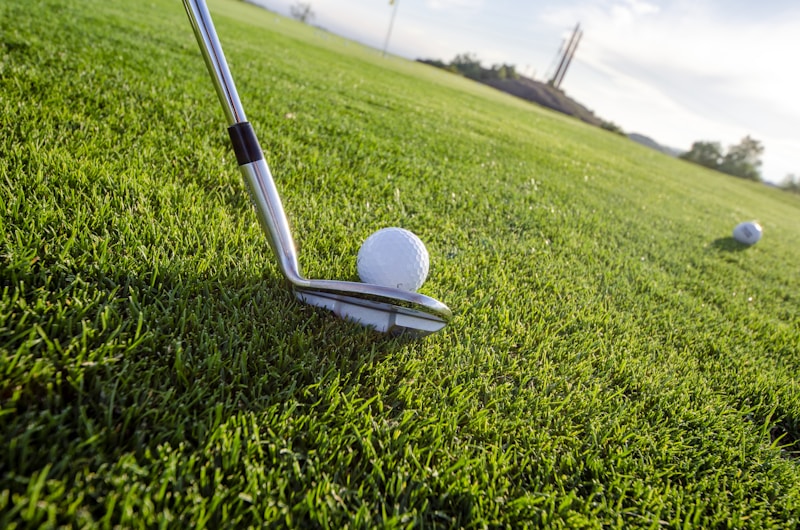
Image credit: Unsplash
 Image credit: Unsplash
You need 7 clubs minimum to play a full round:
- Driver. For tee shots on par 4s and par 5s. Look for 10.5 degrees of loft or higher. Higher loft is more forgiving.
- Fairway wood (3W or 5W). For long shots from the fairway. A 5-wood (18 degrees) is easier to hit than a 3-wood (15 degrees).
- Hybrid (4H or 5H). Replaces hard-to-hit long irons. Much easier to get airborne from the rough.
- 7-iron. Your go-to mid-range club. 140-160 yards for most beginners.
- 9-iron. For shorter approach shots. 100-130 yards.
- Pitching wedge. For shots around 100 yards and chipping near the green.
- Putter. You'll use this more than any other club. 40-50% of your strokes are putts.
Add a 5-iron, 6-iron, 8-iron, and sand wedge when you're ready. Most courses won't enforce the 14-club maximum on a beginner. Use our golf club length calculator to find the right club lengths for your height.
New vs used clubs for beginners
New complete sets ($300-$600): everything matches, shafts are consistent, warranty included. You get a bag and headcovers. Good if you want zero hassle.
Used clubs ($100-$300 for a full bag): better quality per dollar. A 3-year-old Callaway Rogue driver ($80 used) outperforms most drivers in a $350 starter set. Check eBay, Facebook Marketplace, 2nd Swing, and GlobalGolf.com.
If buying used, inspect the grooves on irons (worn grooves lose spin), check grips for cracks (regripping costs $5-$10 per club at most pro shops), and test the driver face for dents. Read our regripping guide if you buy clubs with worn grips.
Graphite vs steel shafts
Image credit: Unsplash
 Image credit: Unsplash
Graphite shafts are lighter (50-70 grams vs 100-130 grams for steel). They're easier to swing faster and help players with slower swing speeds generate more distance. Most beginner sets come with graphite in woods and hybrids.
Steel shafts give more consistent distance control and feedback. They're standard in irons for players with swing speeds above 85 mph.
For beginners with swing speeds under 85 mph (most women and many men over 50), graphite throughout the bag is a good choice. Most beginner sets offer an all-graphite option for $30-$50 more.
Shaft flex
| Driver swing speed | Recommended flex |
|---|---|
| Under 75 mph | Ladies (L) |
| 75-85 mph | Senior (A) |
| 85-95 mph | Regular (R) |
| 95-105 mph | Stiff (S) |
| 105+ mph | Extra Stiff (X) |
Most men start with Regular flex. Most women start with Ladies flex. If you don't know your swing speed, go to a golf store with a launch monitor and hit a few balls. It takes 5 minutes.
What about custom fitting?
Skip custom fitting until you've played for 6-12 months and have a consistent swing. Before that, your swing changes too much for a fitting to hold value.
When you're ready, a full club fitting costs $100-$200 at most pro shops and retailers (often credited toward a purchase). The fitter adjusts club length, lie angle, shaft flex, and grip size based on your swing data. Use our golf club length calculator to get a rough idea of your recommended lengths before the fitting.
Clubs to avoid as a beginner
Blades (muscle-back irons). Titleist 620 MB, Mizuno Pro 225. These have tiny sweet spots. Pros use them for shot shaping. Beginners will hate them.
Long irons (3-iron, 4-iron). Replace these with hybrids. A 4-hybrid goes the same distance as a 4-iron but is 3 times easier to hit from the rough.
60-degree lob wedge. Requires precise contact. If you catch it thin, the ball shoots across the green. A pitching wedge and sand wedge cover everything a beginner needs around the green.
Where to buy
- New sets: Dick's Sporting Goods, Golf Galaxy, PGA Tour Superstore, Amazon, Costco (Kirkland brand)
- Used clubs: 2nd Swing (2ndswing.com), GlobalGolf, eBay, Facebook Marketplace, Callaway Pre-Owned (callawaygolfpreowned.com)
- Demo days: Most golf stores host manufacturer demo days where you can try clubs before buying. Free, no purchase required.
Getting started after buying clubs
Before your first round, spend 2-3 sessions at the driving range. Focus on making solid contact with your 7-iron, pitching wedge, and driver. Read our grip guide to make sure you're holding the club correctly from day one.
Your first course round should be a par-3 course or a 9-hole executive course. These shorter layouts take 2 hours instead of 4 and let you practice without the pressure of holding up experienced golfers behind you.