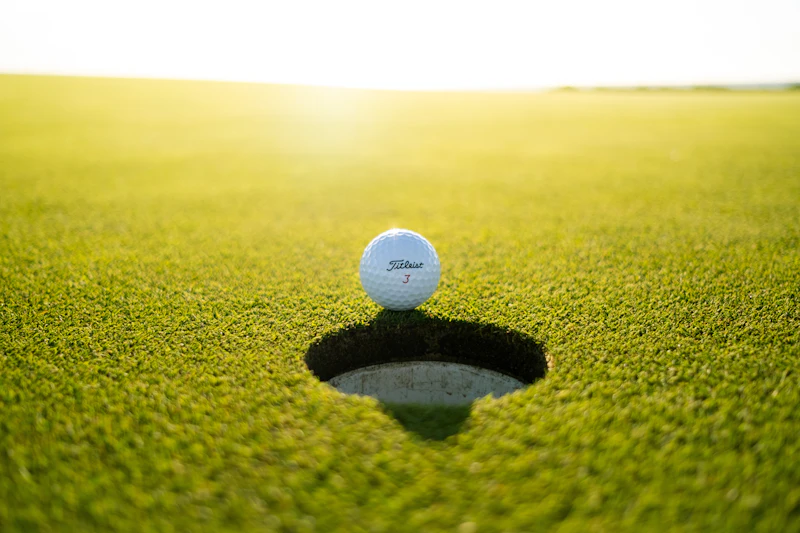

A birdie is 1 stroke under par on any hole. Par-3 in 2 strokes, par-4 in 3, par-5 in 4.
The term dates to 1903 at Atlantic City Country Club in New Jersey. Ab Smith hit an approach shot close to the pin and called it "a bird of a shot." In early 1900s American slang, "bird" meant something excellent. His playing partners adopted the term for any score of 1 under par, and it spread through American golf clubs within a decade.
Birdie by hole type
| Hole type | Par | Birdie score | Typical scenario |
|---|---|---|---|
| Par-3 | 3 | 2 | Hit the green off the tee, sink 1 putt |
| Par-4 | 4 | 3 | Drive, approach to the green, 1 putt |
| Par-5 | 5 | 4 | 3 shots to reach the green, 1 putt |
Most birdies come down to putting. On the PGA Tour, players who convert putts inside 10 feet at higher rates make more birdies than players who hit it closer but putt worse.
How often do golfers make birdies?
| Skill level | Birdie rate | Per 18-hole round |
|---|---|---|
| PGA Tour pro | 15-25% of holes | 3-4 birdies |
| Scratch golfer (0 handicap) | 8-12% of holes | 1-2 birdies |
| 10 handicap | 4-8% of holes | About 1 birdie |
| 20 handicap | 1-3% of holes | 1 every 2-3 rounds |
On the PGA Tour in 2024, the birdie leaders averaged about 4.5 birdies per round. That's roughly 1 birdie every 4 holes. For a 15-handicap amateur, 1 birdie per round is a good day.
 Image credit: Unsplash
Where birdie fits in golf scoring
Golf uses bird-themed names for scores below par, scaled by rarity:
- Albatross (also called double eagle): 3 under par. Extremely rare. Happens roughly once per 6 million shots for amateurs.
- Eagle: 2 under par. PGA Tour players make them on 0.5-1% of holes, mostly on par-5s.
- Birdie: 1 under par.
- Par: Expected score. The baseline.
- Bogey: 1 over par. The most common score for amateurs on most holes.
- Double bogey: 2 over par.
For a full breakdown, see our golf scoring terms guide.
How to score more birdies
1. Pick the right holes
Don't try to birdie every hole. On a typical course, 4-5 holes give you realistic birdie chances based on your game. Short par-4s and reachable par-5s are where most birdies happen.
 Image credit: Unsplash
Study the scorecard before your round. Identify holes under 380 yards (par-4) or under 500 yards (par-5) where you can reach the green in regulation or better.
2. Prioritize approach shots
PGA Tour data shows that approach shot quality (how close you hit it to the pin) correlates with birdie rate more than driving distance. A player who averages 25 feet from the pin on approaches will birdie fewer holes than one who averages 18 feet, regardless of how far they drive.
For most amateurs, hitting more greens in regulation matters more than hitting them close. Just getting on the green in the expected number of shots puts you in birdie position.
3. Practice lag putting
The biggest barrier to birdies for amateurs isn't the long game. It's 3-putting. If you 3-putt twice per round, those are 2 potential birdies turned into pars or worse.
PGA Tour putting conversion rates by distance:
- 3-5 feet: 88%
- 5-10 feet: 57%
- 10-15 feet: 33%
- 15-20 feet: 19%
Most amateurs should focus on getting approach putts inside 3 feet rather than trying to drain 20-footers.
4. Course management
Play to the fat side of the green. Aim for the center when the pin is tucked behind a bunker. Avoid short-sided misses. These decisions won't feel aggressive, but they'll put you on the green more often, and that's where birdies start.
If you're new to the game, our beginner's golf guide covers the fundamentals of swing technique and proper grip that make consistent ball-striking possible.
Birdie on a par-3: the easiest path
Par-3s give the most direct birdie opportunity. You're hitting the green (or near it) with your tee shot, then you need 1 putt.
The keys:
- Club selection: take enough club. Most amateurs come up short on par-3s. The front of the green is better than the bunker short of it.
- Aim center-green unless the pin is easily accessible. A 25-foot putt from the middle of the green is better than a bunker shot.
- Read the putt carefully. You'll likely have a longer putt than on a par-4 birdie attempt, so distance control matters most.
Famous birdies in golf history
Tiger Woods birdied 6 of his last 7 holes to win the 2005 Masters. That stretch is one of the most dominant birdie runs in major championship history.
At the 2019 Masters, Tiger made birdie on 13 and 15 in the final round to build the lead that gave him his 5th green jacket at age 43.
In the 2024 PGA Tour season, Scottie Scheffler led the Tour in birdies-or-better percentage, converting over 23% of his holes into birdies or eagles.
FAQ
What's the difference between a birdie and an eagle?
A birdie is 1 under par. An eagle is 2 under par. Eagles are about 20-30x rarer than birdies on the PGA Tour.
Can beginners make birdies?
Yes. A beginner's best chance is on a short par-3 (under 150 yards). Hit the green, sink a putt. It's rare for new players, but it happens, and it's a great feeling when it does.
Why is it called a birdie?
Ab Smith coined it at Atlantic City Country Club around 1903. "Bird" was slang for "excellent" in early 1900s America. The term spread nationally within 20 years.
How many birdies does a pro make per round?
PGA Tour average is about 3.5-4 birdies per 18-hole round. The best players reach 4.5+ per round over a full season.
Is a birdie good?
Yes. Even for professionals, a birdie means you played a hole better than expected. For amateurs, any birdie is a high point of the round.