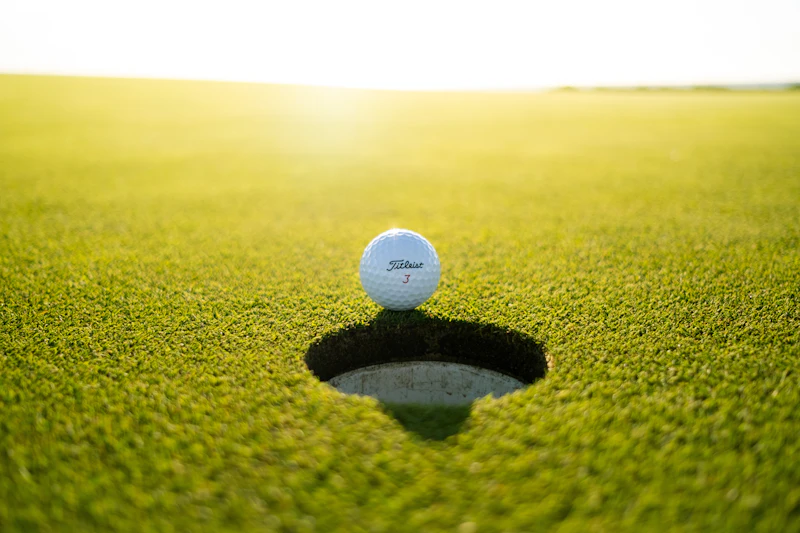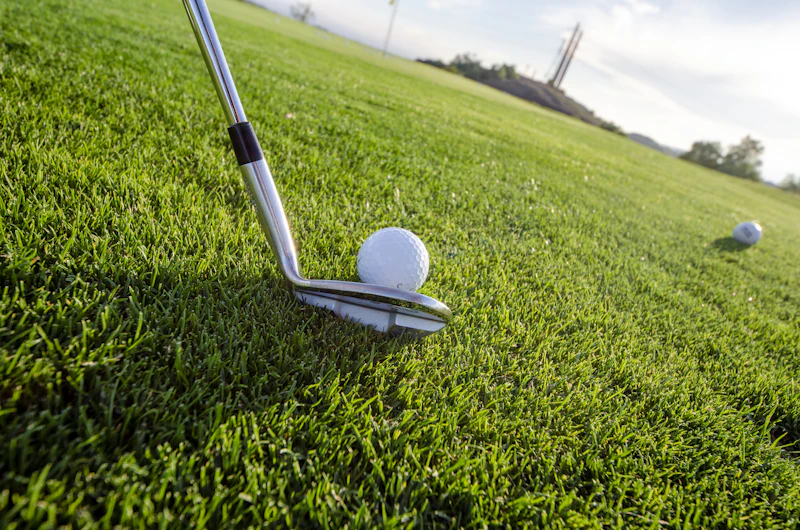

Par is the number of strokes a skilled golfer should take to complete a hole. A par-4 means 4 strokes is the expected score: 2 shots to reach the green, 2 putts.
Every golf hole has a par value (3, 4, or 5) based on its length. A standard 18-hole course adds up to par 70, 71, or 72.
How par is assigned
| Hole type | Men's yardage | Women's yardage | Expected shots to green | Expected putts |
|---|---|---|---|---|
| Par-3 | Up to 250 yards | Up to 210 yards | 1 | 2 |
| Par-4 | 251-470 yards | 211-400 yards | 2 | 2 |
| Par-5 | 471-690 yards | 401-575 yards | 3 | 2 |
Par always assumes 2 putts. A par-4 means reaching the green in 2 shots (that's called "green in regulation") and taking 2 putts. A birdie usually means hitting the green in regulation and sinking a 1-putt.
Par on the scorecard
Par gets no special marking on the scorecard. Birdies get a circle, eagles a double circle, bogeys a square. Par is the baseline, so it's just the number.
 Image credit: Unsplash
When someone says "I shot even par," they mean their total strokes equaled the course par. On a par-72 course, that's 72 strokes. "Two under par" means 70 strokes.
What par means at different levels
For PGA Tour players, par is slightly below average. Tour scoring averages about 70-71 on par-72 courses, meaning pros average 1-2 under par per round.
For amateurs:
- Scratch golfer (0 handicap): shoots around par
- 10 handicap: shoots about 82 (10 over par)
- 20 handicap: shoots about 92 (20 over par)
- Average male golfer: shoots about 96 (24 over par)
If you're a 20-handicap, making par on any hole is a good result. You don't need to par every hole to improve. Just reducing bogeys and double bogeys will lower your score faster.
Course par
Most 18-hole courses are par 70-72. A par-72 course typically has four par-3s, ten par-4s, and four par-5s. Some courses are par 70 (fewer par-5s) or par 71.
 Image credit: Unsplash
Par-3 courses (all 9 or 18 holes are par-3s) are great for beginners. A round takes 1-2 hours, and you only need irons and a putter. You can practice your short game without the pressure of long holes.
Par for the course (the idiom)
"Par for the course" in everyday English means "about what you'd expect." It comes directly from golf: par is the expected number of strokes. If something is par for the course, it's normal.
Related scoring terms
Par sits in the middle of the golf scoring scale. Below par: birdie (-1), eagle (-2), albatross (-3). Above par: bogey (+1), double bogey (+2).
Understanding par is the first step to understanding your handicap and tracking improvement. For a full introduction to the game, see our beginner's golf guide.