Image credit: Unsplash
The longest recorded drive in a professional golf competition is 515 yards, hit by Mike Austin in 1974 at the US Senior National Open at Winterwood Golf Course in Las Vegas.
Austin was 64 years old at the time. He used a persimmon driver with a steel shaft. A 35 mph tailwind and the dry desert air helped carry the ball 415 yards in the air. It rolled another 100 yards on the hard, downhill fairway of the 450-yard par-4 18th hole.
Longest drives on the PGA Tour
| Player | Distance | Event | Year | Notes |
|---|---|---|---|---|
| Davis Love III | 476 yards | Mercedes Championships | 2004 | Downhill, downwind at Kapalua |
| Tiger Woods | 498 yards | Mercedes Championships | 2002 | Kapalua's 18th, ball rolled into a bunker |
| Dustin Johnson | 463 yards | WGC-Mexico | 2017 | 7,800 ft elevation in Mexico City |
| Bryson DeChambeau | 423 yards | Arnold Palmer Invitational | 2021 | Pure carry distance, minimal roll |
| Rory McIlroy | 436 yards | The Players Championship | 2019 | Wind-assisted on the 4th hole |
Most of the longest recorded Tour drives had help from wind, elevation, or downhill terrain. The longest "flat, calm" drives on Tour measure 360-380 yards.
Average driving distance on Tour

Image credit: Unsplash
 Image credit: Unsplash
The PGA Tour average driving distance in 2024 is 299.2 yards. That's up from 269.2 yards in 2000. The increase comes from better driver technology (larger heads, hotter faces, carbon construction) and players getting stronger and faster.
| Year | PGA Tour avg drive | Longest avg on Tour |
|---|---|---|
| 2000 | 269 yards | John Daly (301 yards) |
| 2005 | 289 yards | Scott Hend (318 yards) |
| 2010 | 287 yards | Robert Garrigus (315 yards) |
| 2015 | 289 yards | Dustin Johnson (317 yards) |
| 2020 | 296 yards | Bryson DeChambeau (322 yards) |
| 2024 | 299 yards | Rory McIlroy (326 yards) |
World Long Drive Championship records
The World Long Drive Championship is a separate competition where specialists hit with maximum effort, no accuracy required. The ball just has to land in a grid.
Kyle Berkshire holds the world record at 480 yards, set in 2023. His ball speed regularly exceeds 230 mph (PGA Tour average is about 170 mph). Berkshire swings at 155+ mph clubhead speed; the Tour average is 113 mph.
Long drive competitors use clubs with extra-long shafts (48 inches, the USGA max for competition) and low-spin ball setups to maximize distance. Their technique prioritizes speed over accuracy.
Average driving distance for recreational golfers
| Handicap | Average drive |
|---|---|
| Scratch (0) | 250-260 yards |
| 5 handicap | 235-245 yards |
| 10 handicap | 220-230 yards |
| 15 handicap | 200-215 yards |
| 20 handicap | 185-200 yards |
| 25+ handicap | 170-190 yards |
If you're hitting your driver 200 yards, you're in the average range for a recreational male golfer. 230+ yards puts you above average. Don't compare yourself to PGA Tour numbers.
 Image credit: Unsplash
What affects driving distance

Image credit: Unsplash
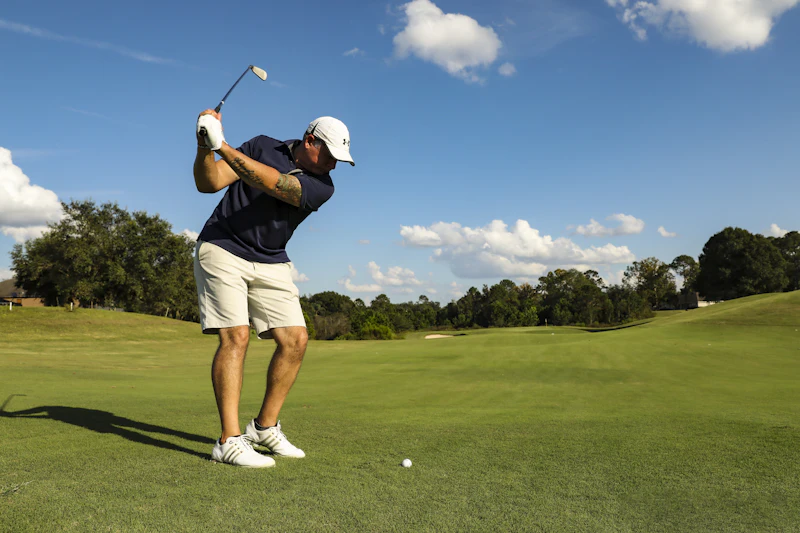
Club head speed. The biggest factor. Every 1 mph increase in swing speed adds roughly 2.5 yards of carry distance. A 100 mph swing produces about 250 yards of carry with a modern driver.
Launch angle. Optimal launch for most amateur swing speeds (90-100 mph) is 12-15 degrees. Too low and the ball doesn't carry. Too high and you lose distance to excessive spin.
Spin rate. Between 2,000 and 2,500 rpm is ideal for most amateurs. Over 3,000 rpm and the ball balloons and falls short. Under 1,500 rpm and it won't stay in the air.
Ball speed. Generated by the combination of clubhead speed and strike quality. Center-face contact produces the highest ball speed. Hits toward the toe or heel lose 5-15 yards.
Conditions. Wind, temperature, humidity, elevation, and ground firmness all matter. A ball travels about 2 yards farther per 1,000 feet of elevation. Cold air (40°F) costs about 5-8 yards compared to warm air (80°F).
How to hit it farther
Speed training works. Programs like SuperSpeed Golf or Rypstick use overspeed training (swinging lighter and heavier clubs) to increase clubhead speed. Most users gain 5-8% in 6-8 weeks. That's 5-8 mph on a 100 mph swing, adding 12-20 yards.
Getting properly fit for your driver matters more than buying the newest model. A fitting that corrects your loft, shaft flex, and tee height can add 10-20 yards without changing your swing.
Using a lower-spin ball (2-piece distance ball) instead of a tour ball (Pro V1, Chrome Soft) can add 10-15 yards for players with swing speeds under 95 mph. Check our golf balls guide for recommendations.
Equipment behind the distance explosion
Modern drivers are engineered for maximum ball speed:
| Era | Driver head material | Head size | Shaft material | Typical carry |
|---|---|---|---|---|
| Pre-1980 | Persimmon wood | 150-180cc | Steel | 200-230 yards |
| 1980-1995 | Steel/stainless | 200-250cc | Steel/early graphite | 220-250 yards |
| 1995-2005 | Titanium | 300-400cc | Graphite | 240-270 yards |
| 2005-2015 | Titanium face, composite crown | 460cc (USGA max) | Graphite | 260-285 yards |
| 2015-present | Multi-material (titanium, carbon, tungsten) | 460cc | Advanced graphite | 275-300+ yards |
The USGA capped COR (coefficient of restitution) at 0.830 in 1998 and head size at 460cc in 2004. These limits prevent manufacturers from making drivers any "hotter." Recent gains come from reducing spin through weight distribution and improving consistency on off-center hits through AI-designed face thickness patterns.
The golf ball has evolved too. Multi-layer urethane balls launched in the late 1990s (Titleist Pro V1 debuted in 2000) with lower driver spin and higher launch. This combination added 15-20 yards compared to wound balata balls of the 1990s.
Does distance matter for scoring?
PGA Tour stats show a clear correlation between driving distance and scoring average. The 20 longest hitters on Tour average 0.3-0.5 strokes per round better than the 20 shortest hitters. That's 1.2-2.0 strokes per tournament, which translates to hundreds of thousands of dollars in earnings.
For amateur golfers, distance helps less than accuracy. A study by Arccos (GPS shot tracking) of 100 million amateur shots found that hitting more fairways reduced scores more than hitting longer drives for golfers with handicaps above 10.
The optimal amateur strategy: hit driver on holes where a miss still leaves a reasonable second shot. Use 3-wood or hybrid on tight holes where the penalty for a missed drive is severe (thick rough, out of bounds, water). Course management matters more than swing speed for recreational golfers.
The future of distance in golf
In 2023, the USGA and R&A proposed a Model Local Rule allowing tournaments to require a shorter-flying ball (the "rollback"). The rule would reduce driving distances by 15-20 yards for the fastest swingers (145+ mph ball speed) while having minimal effect on amateur distances.
The PGA Tour and Augusta National support the change. LIV Golf has not committed to adopting it. Implementation is expected by 2028. This is the most significant equipment regulation since the USGA limited driver head size in 2004.