Image credit: Unsplash
Pin high (also called hole high) means your ball is level with the flagstick in terms of distance. The ball might be left or right of the pin, but it traveled the correct distance to reach the hole.
If the pin is 150 yards away and your ball lands 150 yards out but 20 feet right of the flag, you're pin high. You had the right distance, wrong direction.
Why pin high matters
Distance control is the most important skill in approach shots. PGA Tour stats show that golfers miss the green more often by being long or short than by being left or right. Getting pin high means you judged the yardage correctly, which is the harder part.
If you're consistently pin high, your scoring will improve because:
- Putts from the same distance as the pin (but left or right) are generally easier than putts from short or long.
- Being short of the pin means you're often still in front of the green or in a bunker. Being long means you're over the green with a downhill chip.
- A chip or pitch from pin-high left or right of the green is usually a straightforward shot to a relatively flat landing area.
Pin high vs on the green
Pin high doesn't mean on the green. Your ball could be pin high in the rough 30 feet right of the flag. You could also be on the green but 40 feet short of pin high.
 Image credit: Unsplash
The two concepts are independent:
| Scenario | Pin high? | On the green? |
|---|---|---|
| Ball is level with pin, 15 feet right, on the green | Yes | Yes |
| Ball is level with pin, 25 feet left, in the rough | Yes | No |
| Ball is 20 feet short of pin, on the green | No | Yes |
| Ball is 30 feet past the pin, off the back of the green | No | No |
How to be pin high more often
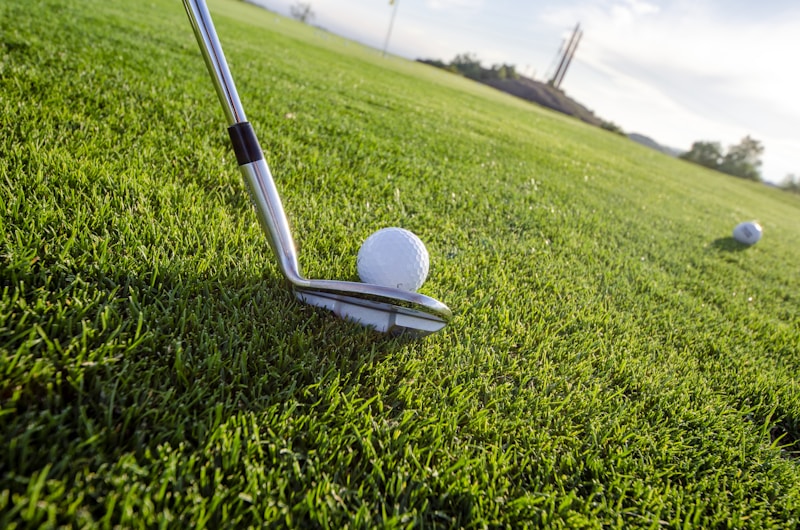
Image credit: Unsplash
Know your distances. Go to the range with a launch monitor or GPS app and hit 10 balls with each iron. Record the average carry distance. Most amateurs overestimate how far they hit each club by 10-15 yards.
| Club | Average male carry (15 hcp) | PGA Tour average carry |
|---|---|---|
| 7-iron | 140 yards | 172 yards |
| 8-iron | 130 yards | 160 yards |
| 9-iron | 120 yards | 148 yards |
| PW | 105 yards | 134 yards |
Play for carry, not total distance. The carry number is what you control. Roll-out depends on the firmness of the green, spin, and landing angle. Use your carry distance when selecting a club.
Factor in conditions. Into the wind, club up (add 1 club per 10 mph of headwind). Downhill, club down. Uphill, club up. Cold weather (under 50°F) costs 5-10 yards per club.
Use a rangefinder or GPS. Handheld GPS units ($100-$200) or rangefinders ($150-$400) give you exact distance to the pin. Bushnell, Garmin, and Blue Tees are the most popular brands.
What PGA Tour pros say about pin high
When broadcast commentators say "that's pin high," they're praising distance control. On Tour, the best approach players (Scottie Scheffler, Collin Morikawa, Rory McIlroy) are pin high on 75-80% of their approach shots.
 Image credit: Unsplash
The "proximity to hole" stat on Tour averages about 32 feet from 150-175 yards. The best players average 25-28 feet. The difference between a good approach player and an average one is often just 5-7 feet of distance control.
How to practice distance control
Distance control is a learnable skill. These drills help:
Ladder drill. Hit 10 balls with your 8-iron. Try to land each ball 5 yards farther than the last. Start at 100 yards, then 105, 110, 115, etc. This teaches you to feel the difference between distances with the same club.
Clock drill. With your pitching wedge, hit shots at "9 o'clock" (backswing to hip height), "10 o'clock" (backswing to ribcage), and "11 o'clock" (backswing to shoulder). Measure how far each goes. These become your go-to distances for partial wedge shots inside 100 yards.
Range finder practice. On the course, range the pin before every approach shot. Over time, you'll develop an instinct for distance. Within 3-4 months of consistent ranging, most golfers improve their approach shot proximity by 10-15%.
Why most amateurs miss short
Three reasons amateurs leave approach shots short of pin high:
- Ego distance. A golfer hits their 7-iron 155 yards on the range (their best shot). From 155 yards on the course, they pull 7-iron. Their average 7-iron is actually 142 yards. They come up short.
- Not accounting for elevation. An uphill approach plays 5-10 yards longer. Most golfers don't adjust.
- Mis-hits. Range shots are off flat lies with perfect turf. Course shots are off sloped lies, rough, divots, and uneven ground. Average contact quality on the course is worse than on the range.
The fix: use your average distance (not your best), add a club for uphill and into-wind shots, and accept that your on-course distance is 5-10% less than your range distance.