A regulation golf ball weighs no more than 1.62 ounces (45.93 grams), has a diameter of at least 1.68 inches (42.67 mm), and has 300-500 dimples. These specs are set by the USGA and R&A.
Construction types
2-piece balls
A solid rubber core wrapped in a durable cover. Maximum distance, minimum spin. Best for beginners and high handicappers who want the ball to go straight and far. $15-25 per dozen.
Examples: Titleist Velocity, Callaway Warbird, Kirkland Signature.
3-piece balls
Core, mantle layer, and cover. More spin control than 2-piece, especially on short shots. Good for mid-handicappers (10-20 handicap) who want some greenside spin without sacrificing too much distance. $25-40 per dozen.
Examples: Bridgestone e6, TaylorMade Tour Response, Callaway Chrome Soft.
4 and 5-piece balls
Multiple layers each tuned for different shot types. Low driver spin for distance, high wedge spin for control. These are what Tour pros use. $45-55 per dozen.
Examples: Titleist Pro V1 (4-piece), TaylorMade TP5 (5-piece), Callaway Chrome Soft X.
Cover materials
Surlyn (ionomer)
Hard, durable. Used on most 2-piece balls. Resists cuts and scuffs. Lower spin around the greens. A Surlyn ball can last several rounds without visible damage.
 Image credit: Unsplash
Urethane
Soft, generates more spin on wedge shots. Used on premium 3-5 piece balls. Scuffs more easily than Surlyn. One cart path hit can damage a urethane cover. Worth it if your short game can use the extra spin.
Dimples explained
Dimples create turbulence in the air layer around the ball, which reduces drag and adds lift. A smooth ball hit by a pro would travel about 130 yards. A dimpled ball travels 270+ yards. That's how much difference dimples make.
Most balls have 320-400 dimples. The exact number and pattern vary by manufacturer. The number itself doesn't matter as much as the overall aerodynamic design. Titleist Pro V1 has 388 dimples. Callaway Chrome Soft has 332.
Compression
Compression measures how much the ball deforms when struck. Rated on a scale, with most balls ranging from 30 to 100+.
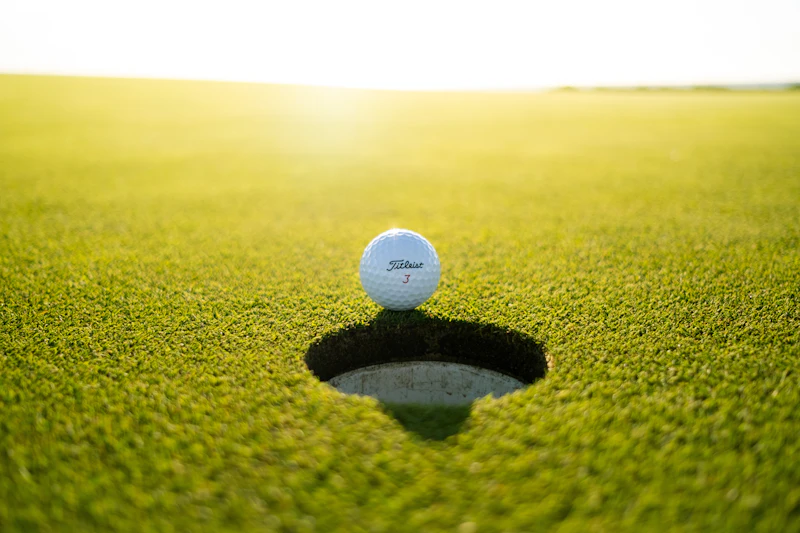 Image credit: Unsplash
| Compression | Best for | Swing speed |
|---|---|---|
| 30-50 (low) | Beginners, seniors, slow swingers | Under 85 mph |
| 50-75 (mid) | Average amateur golfers | 85-100 mph |
| 75-100+ (high) | Fast swingers, low handicappers | Over 100 mph |
If your swing speed is under 85 mph, a low-compression ball will feel better and fly farther than a high-compression ball. You don't compress a high-compression ball enough to get full distance.
How far should a golf ball go?
| Club | Average amateur (male) | PGA Tour average |
|---|---|---|
| Driver | 200-230 yards | 295 yards |
| 7-iron | 140-160 yards | 185 yards |
| PW | 100-120 yards | 140 yards |
Which ball should you buy?
If you lose more than 3 balls per round, buy the cheapest ball you can find. Kirkland Signature 3-piece balls ($25/two dozen at Costco) are hard to beat for the price.
If you break 90 consistently and lose fewer than 2 balls per round, a mid-range ball like the Callaway Chrome Soft or Bridgestone Tour B RX gives you more control without the premium price.
If you're a single-digit handicap with swing speed over 100 mph, the Pro V1, TP5, or Z-Star give you the spin separation and control you can actually use.
Related: how to hit a golf ball, swing guide, beginner's guide.