
Image credit: Unsplash
There are 5 types of golf clubs: woods, irons, hybrids, wedges, and putters. The USGA allows a maximum of 14 clubs in your bag during a round.
Club types at a glance
| Club type | Used for | Typical distance (men) | Clubs in this category |
|---|---|---|---|
| Woods | Tee shots, long fairway shots | 200-300 yards | Driver, 3-wood, 5-wood, 7-wood |
| Hybrids | Replacing long irons, multiple uses | 170-220 yards | 2H, 3H, 4H, 5H |
| Irons | Approach shots, tee shots on short holes | 130-200 yards | 3-iron through 9-iron |
| Wedges | Short approach, chipping, bunkers | 40-130 yards | PW, GW, SW, LW |
| Putter | Rolling the ball on the green | On the green | Blade, mallet, or mid-mallet |
Woods
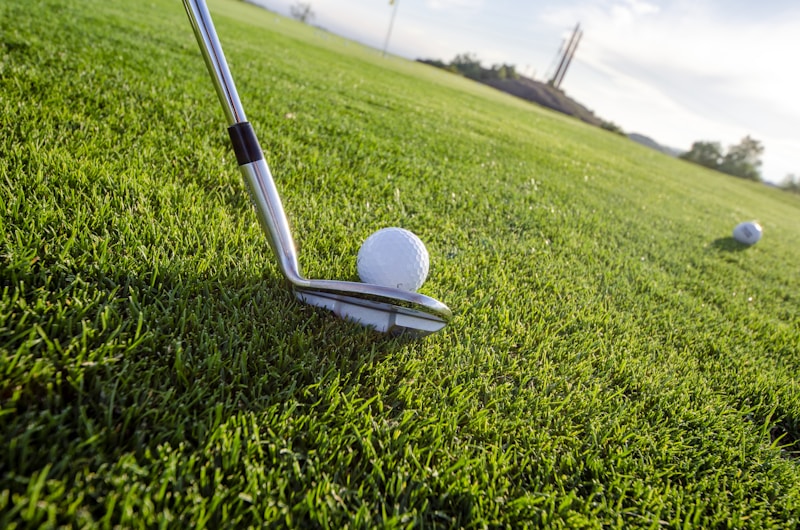
Image credit: Unsplash
 Image credit: Unsplash
Driver (1-wood). The longest club in the bag. Standard length: 45-45.75 inches. Loft: 9-12 degrees. Modern drivers have 460cc titanium or carbon heads (the USGA maximum). Used almost exclusively off the tee.
Most golfers carry a driver. It's the club that hits the ball farthest, and you use it on every par 4 and par 5 tee shot.
Fairway woods (3W, 5W, 7W). Smaller heads than a driver (150-200cc), designed to hit off the ground or from a tee on tight holes. A 3-wood (15 degrees) goes 210-240 yards for most men. A 5-wood (18 degrees) goes 195-220 yards.
The 5-wood is easier to hit than the 3-wood because of the higher loft. If you struggle with fairway woods, try a 7-wood (21 degrees). It launches higher and is more forgiving from the rough.
Hybrids
Hybrids combine the head shape of a fairway wood with the length of an iron. They replaced long irons (3-iron, 4-iron) because they're easier to hit from bad lies, rough, and tight fairways.
A 4-hybrid goes roughly the same distance as a 4-iron (190-200 yards) but launches higher and stops faster on the green. About 85% of PGA Tour players carry at least 1 hybrid. Among amateur golfers, nearly everyone benefits from replacing their 3 and 4 irons with hybrids.
| Hybrid | Replaces | Loft | Distance (men) |
|---|---|---|---|
| 2-hybrid | 2-iron | 17-18 degrees | 210-230 yards |
| 3-hybrid | 3-iron | 19-21 degrees | 195-215 yards |
| 4-hybrid | 4-iron | 22-24 degrees | 185-200 yards |
| 5-hybrid | 5-iron | 25-27 degrees | 175-190 yards |
Irons
Irons are numbered 3 through 9. Lower numbers (3, 4, 5) go farther with less loft. Higher numbers (7, 8, 9) are shorter with more loft and accuracy.
 Image credit: Unsplash
Long irons (3-5): 170-210 yards. Hardest to hit. Most beginners and mid-handicap golfers replace these with hybrids.
Mid irons (6-7): 150-180 yards. The 7-iron is the most commonly used iron and often the first club a beginner learns to hit.
Short irons (8-9): 130-160 yards. Higher accuracy, used for approach shots into the green.
Irons come in 3 head designs:
- Cavity back (game improvement): Hollowed-out back, weight around the perimeter. Most forgiving on mis-hits. Best for handicaps 10 and above.
- Players cavity: Slightly smaller head, thinner topline. For handicaps 5-15 who want some forgiveness with better feedback.
- Blade (muscle back): Solid back, small sweet spot, maximum control. For scratch golfers and pros. Hard to hit consistently.
Wedges

Image credit: Unsplash
Wedges are specialized short irons with high loft for shots inside 130 yards, chipping, and bunker play.
| Wedge | Loft | Full swing distance | Primary use |
|---|---|---|---|
| Pitching wedge (PW) | 44-48 degrees | 110-130 yards | Full approach shots, bump-and-run chips |
| Gap wedge (GW) | 50-52 degrees | 90-110 yards | Fills the gap between PW and SW |
| Sand wedge (SW) | 54-56 degrees | 70-90 yards | Bunker shots, pitch shots around the green |
| Lob wedge (LW) | 58-60 degrees | 50-70 yards | High, soft shots over obstacles; tight lies around greens |
The pitching wedge comes with your iron set. Sand wedge and lob wedge are usually bought separately. Cleveland, Titleist Vokey, and Callaway Jaws are the most popular wedge brands.
Beginners should carry a PW and SW. Add a gap wedge and lob wedge as your short game develops.
Putters
You'll use the putter more than any other club. PGA Tour pros average 28-30 putts per round. Amateur golfers average 32-40 putts.
Three main designs:
- Blade putters (Scotty Cameron Newport, Ping Anser): simple head, good for players with an arcing stroke. Most popular on Tour.
- Mallet putters (Odyssey 2-Ball, TaylorMade Spider): larger head, more forgiveness, alignment aids. Good for straight-back-straight-through strokes.
- Mid-mallet: splits the difference. Moderate size with some alignment help.
Putter length matters. Standard is 34-35 inches. If you're under 5'8", try a 33-inch putter. Over 6'2", try a 35-36 inch putter. Your eyes should be directly over the ball at address. Use our club length calculator to check your recommended putter length.
Sample bag setups
| Beginner (10 clubs) | Mid-handicap (13 clubs) | Low handicap (14 clubs) | |
|---|---|---|---|
| Driver | Driver (10.5 degrees) | Driver (9.5-10.5 degrees) | Driver (9-10.5 degrees) |
| Woods | 5-wood | 3-wood, 5-wood | 3-wood |
| Hybrids | 5-hybrid | 4-hybrid | 3-hybrid, 4-hybrid |
| Irons | 7, 9 | 5-9 | 4-9 |
| Wedges | PW, SW | PW, GW, SW | PW, 50, 54, 58 |
| Putter | Mallet | Mallet or blade | Blade or mid-mallet |
How many clubs should you carry?
The USGA allows 14 clubs maximum. You get a 2-stroke penalty for each hole played with more than 14 (up to 4 strokes max in stroke play; loss of hole in match play).
You don't have to carry 14. Many beginners play with 7-10 clubs and do fine. The 14-club limit becomes relevant as you develop your game and want specific clubs for specific distances.
The most common 14-club setup on the PGA Tour: driver, 3-wood, 2 hybrids or long irons, 5-9 iron, pitching wedge, gap wedge, sand wedge, lob wedge, putter. Some players carry a 5-wood instead of a second hybrid. Others drop the lob wedge for an extra fairway wood.
Technology changes in golf clubs
Golf clubs have changed dramatically in the last 30 years:
Drivers: From 150cc persimmon wood heads to 460cc titanium-carbon composites. Sweet spots are 3-4 times larger. Average driving distance on the PGA Tour increased 30+ yards between 1995 and 2024.
Irons: "Strong lofts" have changed what each iron number means. A modern 7-iron (29-30 degrees) has the same loft as a 6-iron from the 1990s (30-31 degrees). Manufacturers de-lofted irons and lengthened shafts so golfers hit each number farther, even though the physics haven't changed.
Wedges: CNC milling (computer-controlled precision grinding) creates sharper, more consistent grooves. Fresh wedge grooves generate 1,000-2,000 more rpm of spin than worn grooves. The USGA standardized groove dimensions in 2010 to limit spin rates.
Putters: Face insert technology (elastomer inserts, grooved faces) creates more consistent ball speed and feel. Larger mallet heads with high MOI (moment of inertia) resist twisting on off-center strikes.
When to upgrade your clubs
If your clubs are less than 5 years old and fit your body, you probably don't need new ones. Technology improvements between model years (2024 vs 2025) are marginal: 1-2 yards and slightly better forgiveness.
Upgrade when:
- Your clubs are 7+ years old (meaningful technology gap).
- Your swing has changed significantly (lost or gained speed, changed mechanics).
- You've never been fit and your clubs are standard off-the-rack.
- Iron grooves are visibly worn (less spin on approach shots).
- Grips are hard, cracked, or slick (regrip before replacing the whole club).