Image credit: Unsplash
The most expensive mass-market golf ball is the Titleist Pro V1x Left Dash at about $55/dozen ($4.58 per ball). Luxury/specialty balls like the Dixon Fire run $75/dozen. Novelty gold-plated balls sell for $100-$1,000+ each.
Most expensive golf balls you can buy
| Ball | Price per dozen | Price per ball | Type |
|---|---|---|---|
| Dixon Fire | $75 | $6.25 | Premium 3-piece, eco-friendly |
| Titleist Pro V1x Left Dash | $55 | $4.58 | Tour-level, low spin, high trajectory |
| Titleist Pro V1 | $55 | $4.58 | The most played ball on the PGA Tour |
| TaylorMade TP5x | $50 | $4.17 | 5-piece construction, high ball speed |
| Callaway Chrome Soft X | $50 | $4.17 | 4-piece urethane, Tour ball |
| Bridgestone Tour B X | $48 | $4.00 | Tiger Woods' ball, reactive urethane cover |
| Srixon Z-Star XV | $45 | $3.75 | 4-piece, high launch, low spin |
Why do premium golf balls cost $50-$75 per dozen?
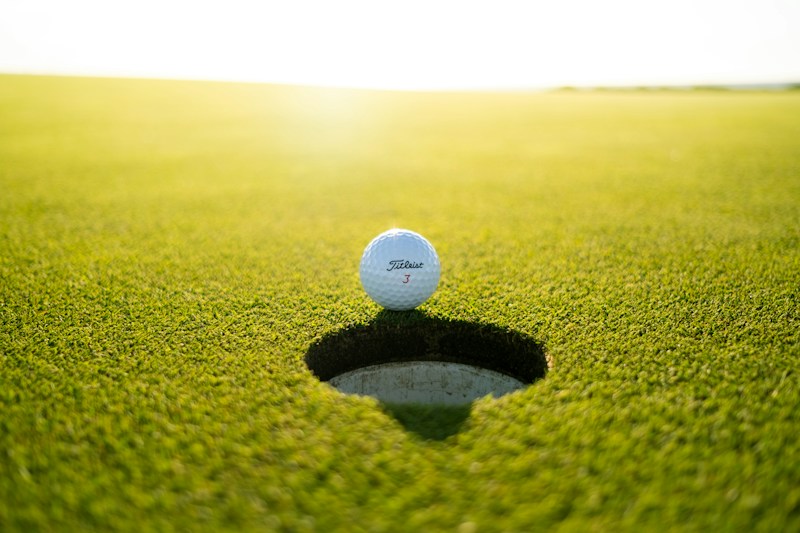
Image credit: Unsplash
 Image credit: Unsplash
Construction. Premium balls have 3-5 layers. Each layer has a different material and purpose:
- Core: Large, soft polybutadiene rubber. Generates ball speed and low driver spin.
- Mantle layers (1-3): Control spin on iron and wedge shots. Separate driver performance from short game performance.
- Cover: Urethane (premium) vs Surlyn/ionomer (budget). Urethane is softer, grips wedge grooves for more spin, and costs 3-4x more to produce.
The urethane cover is the biggest cost differentiator. A urethane cover costs roughly $3-$5 per ball to manufacture. A Surlyn cover costs under $1. That explains most of the price gap between a $15/dozen distance ball and a $50/dozen tour ball.
Quality control. Titleist inspects every Pro V1 for weight, size, concentricity, and paint quality. Each ball must weigh 45.93 grams (within 0.5 grams) and measure 1.68 inches in diameter. Balls that fail inspection are sold as practice balls or destroyed.
Premium vs mid-range vs budget balls
| Premium ($45-$55/doz) | Mid-range ($25-$35/doz) | Budget ($15-$20/doz) | |
|---|---|---|---|
| Cover | Urethane (soft, spin) | Ionomer or budget urethane | Surlyn (hard, durable) |
| Layers | 3-5 piece | 2-3 piece | 2 piece |
| Greenside spin | High (5,500-7,000 rpm) | Medium (4,000-5,500 rpm) | Low (3,000-4,500 rpm) |
| Driver distance | Similar | Similar | Similar (within 5 yards) |
| Feel | Soft, responsive | Medium | Firm, clicky |
| Best for | Single-digit handicaps, Tour players | Mid-handicaps (10-20) | Beginners, high handicaps |
| Examples | Pro V1, TP5, Chrome Soft | Vice Pro, Snell MTB, Srixon Soft Feel | Callaway Supersoft, Top Flite, Noodle |
Are expensive golf balls worth it?
For beginners and high handicaps (20+): No. You'll lose 3-6 balls per round in water, woods, and out of bounds. At $4.50 per ball, that's $13-$27 per round just in lost balls. Use a $15/dozen ball (Callaway Supersoft, Pinnacle Rush) until you stop losing them. Check our golf balls guide for more options.
 Image credit: Unsplash
For mid-handicaps (10-19): Maybe. If you can feel the difference around the greens and you lose fewer than 2 balls per round, a mid-range ball like Vice Pro ($35/dozen) or Snell MTB ($34/dozen) gives you 90% of the premium experience at 60% of the price.
For low handicaps (under 10): Yes. The spin control difference between a Pro V1 and a budget ball is 2,000+ rpm on wedge shots. That's the difference between a ball that checks and spins back vs one that bounces through the green. At this skill level, the ball materially affects scoring.
Best value premium balls
| Ball | Price/dozen | Why it's a deal |
|---|---|---|
| Kirkland Signature (Costco) | $15 | 3-piece urethane cover. Performs within 5% of Pro V1 in independent tests. Best value in golf. |
| Vice Pro | $35 | 4-piece urethane, direct-to-consumer pricing. Buy in bulk ($25/doz for 5+ dozen). |
| Snell MTB Black | $34 | Designed by Dean Snell (co-designer of Pro V1). Tour-quality at half the price. |
| Maxfli Tour | $35 | Dick's house brand. 3-piece urethane. Surprisingly good spin and feel. |
The world's most expensive novelty golf balls
Gold Dipped Golf Balls: 24-karat gold-plated Pro V1s sell for $100-$300 each. They're display items, not for play.
Diamond-Encrusted Balls: Custom jewelers have created diamond-studded golf balls valued at $10,000+. These are art pieces or luxury gifts.
Personal Logo Balls: Getting your company logo or initials printed on premium balls adds $5-$15/dozen. Titleist, Callaway, and TaylorMade all offer custom imprinting with a minimum order of 12 dozen.
How golf ball construction affects price
The number of layers is the primary cost driver:
2-piece balls ($10-$20/dozen): Solid core + hard ionomer cover. Simple manufacturing, fast production. The Callaway Supersoft, Titleist Velocity, and Srixon Soft Feel are 2-piece balls. They go far off the driver and are durable, but they don't spin much around the green.
3-piece balls ($20-$40/dozen): Core + mantle layer + cover. The mantle layer separates driver spin behavior from wedge spin behavior. This allows low spin off the driver (more distance) and higher spin off wedges (more control). The Kirkland Signature, Vice Pro Soft, and Srixon Q-Star Tour are 3-piece balls.
4-piece balls ($40-$55/dozen): Core + 2 mantle layers + urethane cover. Each layer is tuned for different shots. The Titleist Pro V1, Callaway Chrome Soft, and TaylorMade TP5 are 4-piece balls. The extra mantle layer adds spin control in the 50-100 yard range.
5-piece balls ($45-$55/dozen): The TaylorMade TP5 and TP5x have 5 layers. The additional layer provides more spin separation between full swings and partial wedge shots. Whether golfers can feel the difference between 4 and 5 layers is debated.
How to choose the right ball
Match the ball to your swing speed and skill level:
| Swing speed | Handicap | Recommended ball type | Example |
|---|---|---|---|
| Under 85 mph | 25+ | 2-piece, low compression | Callaway Supersoft, Srixon Soft Feel |
| 85-95 mph | 15-25 | 3-piece, mid compression | Vice Pro Soft, Kirkland, Srixon Q-Star |
| 95-105 mph | 5-15 | 3 or 4-piece urethane | Pro V1, Chrome Soft, Z-Star |
| 105+ mph | Under 5 | 4 or 5-piece, high compression | Pro V1x, TP5x, Chrome Soft X |
Compression is how hard you need to swing to properly compress the ball. Low compression balls (under 70) feel soft and work for slower swingers. High compression balls (90+) require faster swings to perform correctly.